
Retirement Insights
From Start-Up to Wind Down: Navigating the Pension Plan Life Cycle
November 9, 2026
A pension plan is more than a benefit program. For some employers, Defined Benefit (DB) pension plans play an important role in helping organizations attract and retain employees while providing a predictable source of retirement income. It is a long-term financial commitment that evolves over time as workforce demographics, funding levels, investment strategies and organizational objectives change.
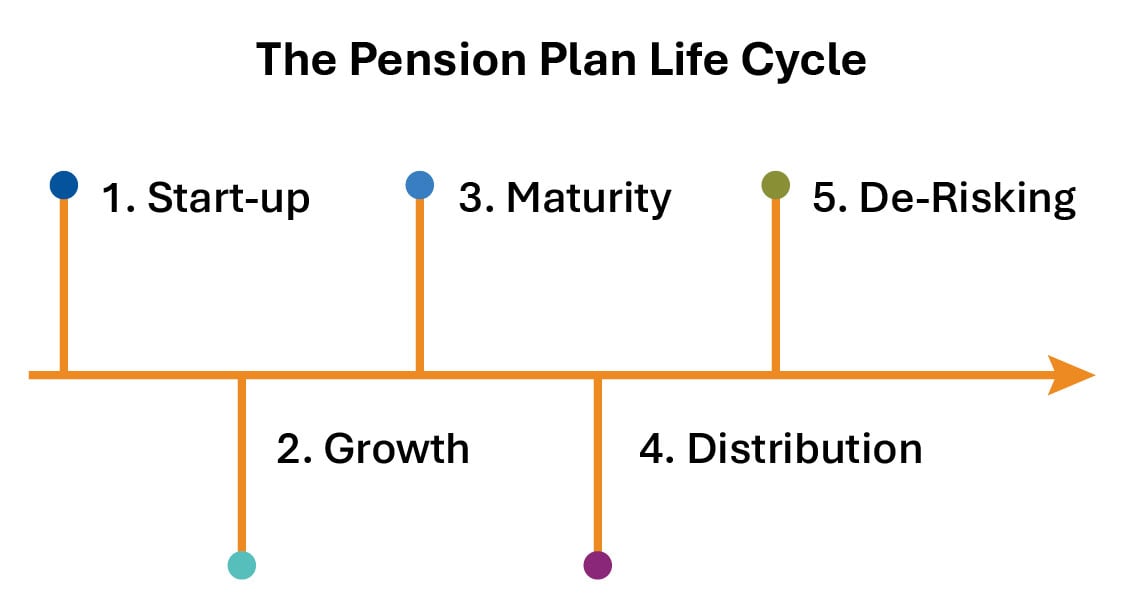 |
As a pension plan progresses through its life cycle, priorities often evolve as well. Early stages typically focus on establishing the plan, communicating the benefit to employees and implementing effective governance and administrative practices. As plans mature, funding, investments and benefit administration become increasingly important. Later stages often involve managing risk, meeting benefit obligations and evaluating long-term plan objectives. |
The pension plan life cycle generally consists of five phases: Start-Up, Growth, Maturity, Distribution and De-Risking. While every plan follows its own path, understanding the characteristics of each phase can help employers anticipate future needs, manage risk and make informed decisions throughout the life of the plan.
The start-up phase is where employers establish the framework for a defined benefit pension plan. Organizations may implement a pension plan to support workforce recruitment and retention, provide employees with retirement security and strengthen their overall benefits strategy.
During this phase, employers define plan objectives, design benefit formulas and establish funding, investment and governance policies. Careful planning and compliance with applicable regulations help create a strong foundation for the future. Clear communication also plays an important role in helping employees understand the value of the benefit and how it supports their long-term retirement goals.
|
|
|
| A manufacturer may implement a pension plan that rewards long-service employees through a benefit formula based on years of service and compensation. | A nonprofit organization may establish a pension plan to enhance its benefits package and compete for talent in a challenging labor market | A city, county or school district may sponsor a pension plan designed to provide career employees with a predictable source of lifetime retirement income |


As a pension plan becomes established, employers shift their focus from implementation to ongoing management. During the growth phase, the goal is to maintain the plan's financial health, support employees' retirement benefits and ensure the plan continues to align with organizational objectives.
This phase often includes regular actuarial valuations, funding assessments and investment reviews. Employers may also enhance governance practices through pension committees and formal oversight processes. As plans become more complex, risk management strategies and online administration tools serve to help employers balance benefit commitments with changing economic and market conditions.
|
|
|
| A growing company formalizes pension oversight through a committee that regularly reviews funding and investment results | A nonprofit evaluates whether its pension program remains competitive in attracting and retaining qualified employees | A public employer works with advisors to monitor funded status and help safeguard long-term benefit obligations |
As a pension plan matures, plan demographics often shifts from active employees to a growing population of retirees and former employees with vested benefits. This changing demographic can affect funding needs, investment strategy and benefit administration priorities.
During this phase, employers may evaluate whether the plan's design, funding policy and investment approach remain aligned with organizational objectives. Managing benefit payments, monitoring funded status and preparing for future obligations become increasingly important as the plan moves closer to a distribution-focused environment.
|
|
|
| Retirees and former employees now represent a larger portion of plan liabilities, prompting a review of funding and investment strategies | A non-profit organization evaluates whether its pension program continues to align with workforce and financial objectives | A public employer monitors demographic shifts and projected benefit payments to support long-term funding decisions |
As a pension plan enters the distribution phase, benefit payments become a primary focus. A growing share of plan assets may be used to support retirees and beneficiaries, requiring employers to balance ongoing benefit obligations with funding, investment and administrative needs.
During this phase, accurate benefit calculations, timely payments and effective recordkeeping are essential. Employers also monitor cash flow, funded status and demographic trends to help ensure the plan can continue meeting its long-term obligations. As administrative demands increase, some employers evaluate whether plan administration functions should remain in-house or be outsourced to specialized providers. Strong governance, regular reviews and compliance oversight help maintain confidence in the plan and its administration.
|
|
|
| A utility company manages a growing retiree population by enhancing benefit administration processes and evaluating whether certain functions should be outsourced to a specialized provider | A hospital system strengthens recordkeeping, cybersecurity and administrative controls to support accurate benefit payments and participant records | A municipality regularly reviews benefit administration, funding progress and pension payment processes to help ensure continued fulfillment of retirement obligations |
As pension plans mature, many employers evaluate strategies to reduce risk, improve funding stability and better align plan obligations with organizational objectives. Depending on the plan's funded status, demographics and long-term goals, employers may consider a range of approaches, from refining investment strategies to reducing pension liabilities.
Potential strategies may include liability-driven investing (LDI), surplus management, lump-sum windows, group annuity purchases and other pension risk transfer solutions. Each option presents unique opportunities, costs and considerations. While some employers ultimately pursue plan termination, others continue operating their plans while implementing measures designed to reduce volatility and improve predictability.
|
|
|
| A corporation may execute a pension risk transfer strategy, such as an annuity buy-out, to reduce balance sheet risk and transfer future benefit obligations to an insurer | A midsize nonprofit may evaluate a lump-sum window program as part of a broader effort to manage future liabilities and administrative complexity | A government agency may align expected returns with investing strategies to better stabilize future plan funding |
Across All Phases: Data Integrity Matters
Regardless of where a pension plan sits in its life cycle, accurate data is essential. Employment histories, compensation records, beneficiary information and participant demographics support funding calculations, benefit determinations, compliance reporting and administrative decisions. Regular data reviews can help employers identify errors early, improve operational efficiency and support informed decision-making throughout the life of the plan.
Technology can help, too. Some firms offer online technology platforms that help employers maintain accurate participant data, streamline plan administration, and access important plan information and reporting. Employees can also benefit from secure online access to retirement information, forms, and other resources, creating a more efficient experience for everyone involved.
Data management best practices include:
- Conduct periodic data audits
- Maintain consistent data standards across HR, payroll and pension systems
- Regularly review participant and beneficiary records
- Establish governance procedures for ongoing data quality
- Utilize technology platforms to centralize data and improve data accessibility and accuracy
Managing the Journey
Managing a defined benefit pension plan is a long-term commitment that evolves over time. From plan design and implementation to ongoing administration, benefit distribution and risk management, each phase presents distinct opportunities and challenges.
While every plan follows its own path, understanding the pension life cycle can help employers make informed decisions, meet their obligations to employees and retirees and align plan strategies with broader organizational goals. By anticipating changing needs and priorities, employers can better position their plans to support both retirement security and long-term organizational objectives.
Support for Every Stage of Your Pension Plan's Journey
Navigating the pension life cycle requires expertise and precision. Whether you need support with plan administration, regulatory compliance, strategic funding decisions or risk management, USI Retirement can help you address the challenges and opportunities associated with each stage of the pension life cycle.
To learn more, please contact your USI retirement consultant, visit our Contact Us page or reach out to us at information@usicg.com.
Investment advice provided to the Plan by USI Advisors, Inc. Under certain arrangements, securities offered to the Plan through USI Securities, Inc. Member FINRA/SIPC. Both USI Advisors, Inc. and USI Securities, Inc. are affiliates of USI Consulting Group.
This information is provided solely for educational purposes and is not to be construed as investment, legal or tax advice. Prior to acting on this information, we recommend that you seek independent advice specific to your situation from a qualified investment/legal/tax professional. | 2126.S1021.99031
INSIGHTS BY TOPIC
Not receiving our newsletter?
Stay up to date with retirement plan updates and insights by subscribing to our email list.